A Tomato Worker, Cécile Spénard-Poisson
Around the canneryone of the 7 articles
Cécile Spénard-Poisson, aged 92, recalls in January 2013 her work as a peeler at the Saint-Pierre tomato cannery: pay by the pail, the autoclaves, and days from seven in the morning to six at night.
Written in French by Jocelyne Lafond, May 26, 2015. Quotations from period documents are left in the original. Lire l’original en français.
The Saint-Pierre tomato cannery, around 1940.
Built in the early 1900s, the Saint-Pierre tomato cannery is now nothing more than a memory. One has to picture the bustle that took hold of the village for a short stretch of the summer, in August and part of September. About forty women and young girls and a dozen men from the area worked at the tomaterie (tomato cannery). That is what we learned from Madame Cécile Spénard-Poisson, who was kind enough to tell us about this part of her young life. In the photograph below she is listening closely to the questions put to her, so as to give precise answers; we thank her for her kindness.

The tomatoes, grown in Saint-Pierre of course, but also throughout the region and even at St-Damase, near St-Hyacinthe, were trucked to the processing plant in St-Pierre.
The men took charge of receiving and weighing the incoming tomatoes, then scalded them for a precise length of time and cooled them quickly; this made the next step easier, a step carried out exclusively by women, who were responsible for peeling the tomatoes and removing every unwanted part.
These women, the « éplucheuses » (peelers), each had their own work station where they received the tomatoes, brought in twenty-pound pails and ready to be peeled; they filled other containers with the peeled tomatoes and set aside the skins, which would later be used to make ketchup — nothing was wasted! Since these workers were paid by the quantity of tomatoes peeled, it was better to be given large, even, blemish-free tomatoes rather than small ones. The ones from St-Damase were known for being big and easier to work with.
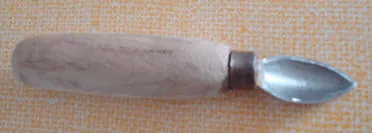
The work was done with a spoon that had a thick handle and sharpened edges (shown here).
The men then came to collect the peeled tomatoes; the next step was the « cannage », the canning; the whole tomatoes were placed in tin cans, and the seaming was done on the line. The cans then had to be sterilized in two or three large autoclaves for a set length of time. We believe the heat in the sterilizer came from a wood fire set under the autoclave; indeed, one of the notarized contracts mentions « bois de chauffage qui est dans la bâtisse » [firewood that is in the building], and since the plant was used only in summer, that wood could have served no other purpose.
Using block and tackle, the canned goods were lifted out of the autoclaves, and the tins were cooled following a precise technique. That is another secret of the preserve’s success. All of this used water, supplied by a private waterworks serving the village; the whole of the canned stock was stored in one corner of the plant. Before the goods were sold off at the end of the season, a label was glued on. The finished product was sold in various markets and shops.
It was the men who were responsible for preparing the ketchup made from the skins. Did they have a secret recipe? Because their work was so varied, they were paid by the hour, unlike the women, who were paid by the piece or by the pail.
This thoroughly seasonal work stretched from seven in the morning to six at night, with a short hour for the midday meal; breaks were a luxury the women workers could not afford, being paid according to their output. Picture these hardy people, up early and to bed late, working in the heat, the damp of the autoclaves and the waste, for a modest income; they helped make the region prosper. It would be good to see another agri-food industry take root here, in these difficult times.
(Remarks gathered in January 2013 from Madame Cécile Spénard-Poisson, aged 92, who worked at the plant. This interview was recorded on video and is kept in the Society’s archives.)
P.S.: In this article we have used the vocabulary employed by the workers of that time.
In this series
Where this article sits
About the Society
A group of volunteers researching, preserving and publishing the history and genealogy of the Lévrard-Becquet seigneury since 2002.
shglb.com/en/une-travailleuse-de-la-tomate-cecile-spenard-poisson/