The Tomato: Its History
Around the canneryone of the 7 articles
From Peru to Saint-Pierre-les-Becquets: four centuries of mistrust of the tomato, held poisonous by John Gerard and merely ornamental by Olivier de Serres, before it reached Canada in the 1850s.
Written in French by Jocelyne Lafond, May 31, 2015. Quotations from period documents are left in the original. Lire l’original en français.
The tomato
(Solanum lycopersicum)
The word “tomato” comes from the Aztec name “tomatl”; it referred to a fruit, the tomatillo, which in Québec is called cerise de terre (ground cherry).
The plant originated in north-western South America, in the region that today corresponds to Peru, Ecuador and Colombia, where it grew wild. Seeds appear to have been carried to Mexico, perhaps by migrating birds; there it was domesticated, and there it grew large enough to be of interest as food. The Spanish came to know it during Hernàn Cortés’s conquest of Mexico in 1519. It was quickly introduced first into Spain, then into Italy, where the city of Naples was under Spanish rule.
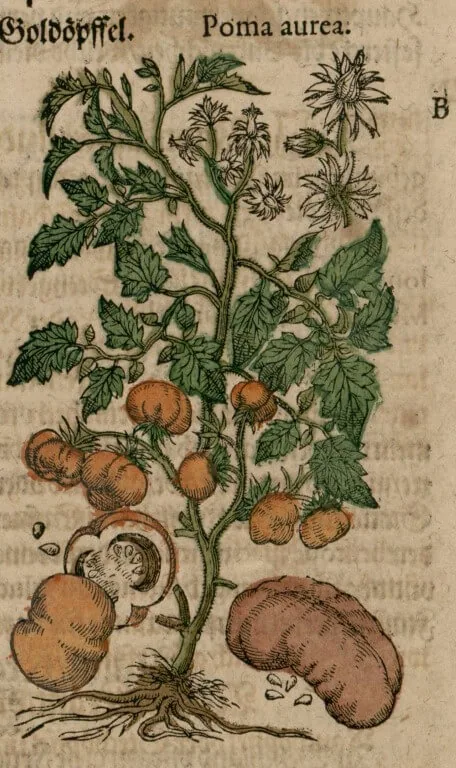
The plant was long regarded with suspicion, because its leaves were toxic; moreover, when it was eaten from lead-based tableware, its acidity dissolved that lead and caused poisoning. Its use was at first limited to “medicinal” and ornamental purposes; even so, it found its way fairly early into Spanish cooking, in the form of gazpacho, that light and refreshing cold soup.
In Italy, as early as 1554, Pietro Andrea Mattioli published a drawing (shown here) of what he called « poma aurea, pomme d’or » [golden apple]; the Italian language has kept the word “pomodoro” for the tomato, which was originally golden in hue.
Spain also ruled the land of Flanders, and a few years later (1557) the Fleming Rembert Dodoens gave a fine description of it under the name « pomme d’amour » [love apple]; he held its consumption to be dangerous. He noted that in German the plant was called “gulden appelen” and “gold opffel”, which proves that it was known in those northern regions at the same period.
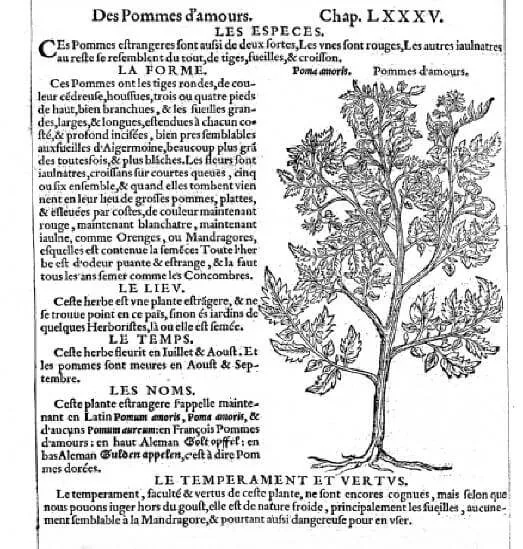
In Great Britain, John Gerard, an English botanist and surgeon, was the first to grow the tomato, in the 1590s. He depicted the plant, which he considered poisonous, fruit included, in his herbal, The Herball or Generall Historie of Plantes. His unfavourable opinion prevailed in Great Britain and in the British colonies of North America for another two centuries.
In France, it appeared first in Provence, neighbour to Italy. In 1600 one of the first French agronomists, Olivier de Serres, classed the tomato among ornamental plants; he wrote in his book « Le théâtre d’agriculture et mesnage des champs », on page 562:
“Les pommes d’Amour, de Merveille, et Dorées, demandent commun terroir et traitement, comme aussi communément servent-elles à couvrir cabinets et tonnelles, grimpans gaiement par dessus, s’agraffans fermement aux appuis. La diversité de leur feuillage, rend le lieu auquel l’on les assemble, fort plaisant et de bonne grace, les gentils fruicts que ces plantes produisent, pendans parmi leur rameure. A l’issue de l’hiver les graines en sont semées, seul moyen de s’engéacer (s’enraciner) de ces plaisants arbustes, dont la délicatesse ne souffre les rudes froidures ; pour laquelle cause ne durent-ils qu’une saison, se mourras, comme les melons et concombres, à l’approche de l’hiver. Leurs fruits ne sont (pas) bons à manger : seulement sont-ils utiles en la médecine, et plaisants à manier et flairer.”
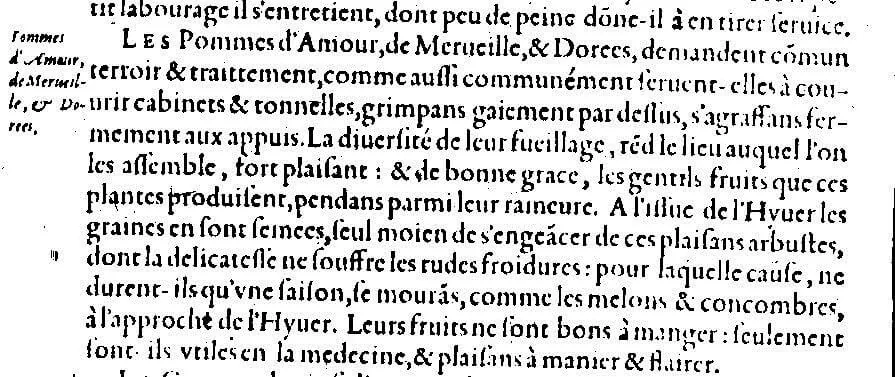
Four hundred years ago, spelling was not yet firmly settled. We have presented the text in this form to make it a little easier to follow.
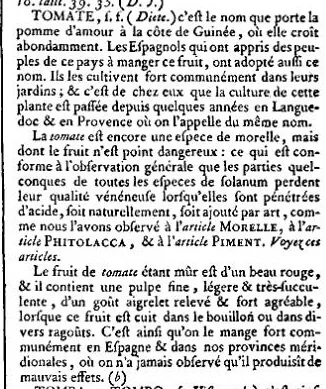
Still in France, but much later, Diderot and d’Alembert published a detailed description of it in their Encyclopédie, and noted that the fruit had only recently been eaten in the southern regions of France, Languedoc and Provence; the French Revolution, through its popular upheavals, allowed it to spread throughout the country.
In northern Europe it did not begin to be used in cooking until around 1750; it is worth noting that the potato, too, met with a great deal of reluctance as a food.
In the United States, President Thomas Jefferson, who had stayed in France in the 1780s, grew tomatoes on his Monticello estate in Virginia and brought them to the presidential table in 1806. His daughter and his sisters left a good number of tomato recipes and so helped to popularise their use. His son-in-law Thomas Mann Randolph wrote that the tomato, all but unknown a few years earlier, was in fashion by 1824.
In Canada, the tomato seems to have been unknown until the 1850s, and to have been timidly introduced by French Canadian textile workers settled in New England, who brought this curiosity home to their native soil.
At that same period, Jean-Baptiste Lelaidier was setting off a revolution in Saint-Pierre-les-Becquets.
Today the tomato is grown all over the world; its production reaches 120 million tonnes.
Things ill understood, things barely known
Fill us with deep mistrust.
When at last their virtues are shown
Then we can give them our trust.*
References:
Archives of the Société d’histoire et de généalogie Lévrard-Becquets (Lévrard-Becquet Historical and Genealogical Society)
Encyclopédie de Diderot et d’Alembert, 1st ed. (1765), vol. 16, p. 396
Olivier de Serres: Le théâtre d’agriculture et mesnage des champs, p. 562
Monticello.org
Wikipedia.org
See the articles on Jean-Baptiste Lelaidier and on the tomato cannery of Saint-Pierre-les-Becquets.
*: a great unrecognised poet
In this series
Where this article sits
About the Society
A group of volunteers researching, preserving and publishing the history and genealogy of the Lévrard-Becquet seigneury since 2002.
shglb.com/en/la-tomate-son-histoire/