The Mill That Became a Waterworks
From lot 419 in the fifth rang, the Moulin des Sources passed from Frédéric Boulanger to the Barabés, who built a waterworks in 1903; the sawmill ran until 1961 and the spring still supplies users.
Written in French by Jocelyne Lafond, April 9, 2017. Quotations from period documents are left in the original. Lire l’original en français.
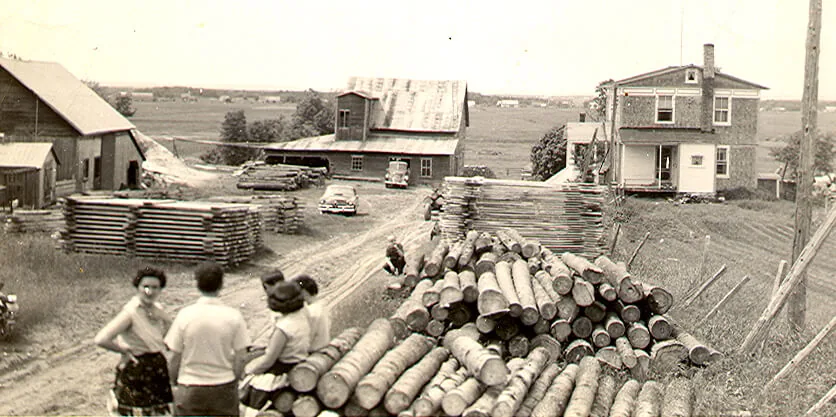
It was a miller from Gentilly who built the Moulin des Sources. According to the 1871 census, Frédéric Boulanger was already settled in the 5th rang (concession road, a row of farm lots) of Saint-Pierre with his wife and their two children, Marie and Rose; he is described as a farmer, but there is no mention of him as a miller.
On 13 March 1873 Frédéric Boulanger borrowed the sum of $400.00 from Pierre Nolasque Chaillez, a bourgeois of Saint-Pierre-les-Becquets. That loan probably served to build a mill, because in 1876, on the occasion of another loan, Frédéric Boulanger pledged as security his land on lot 419, on which a sawmill and gristmill were recorded.
Frédéric Boulanger was then the owner of a very small piece of land (lot 419), roughly 2 arpents and 50 perches in area, on which a sawmill and gristmill had been built. For reasons unknown, he gave up the miller's trade for a time. On 29 October 1880 he made an exchange[1] for a woodlot with Jean-Baptiste Fortier, a farmer of Saint-Jean D'Eschaillons, giving up lot 419, described as «avec les mêmes bornes et voisinage, avec moulin à scie et à farine, moulanges, chaussée sur le ruisseau des Sources servant à faire fonctionner le moulin, fournitures et dépendances qui servent à l'exploitation du moulin, une maison et une étable.» [with the same bounds and neighbours, with sawmill and gristmill, millstones, the dam on the ruisseau des Sources used to work the mill, the supplies and outbuildings used in running the mill, a house and a stable]. In a few years he had turned a small parcel of land into a thriving business.
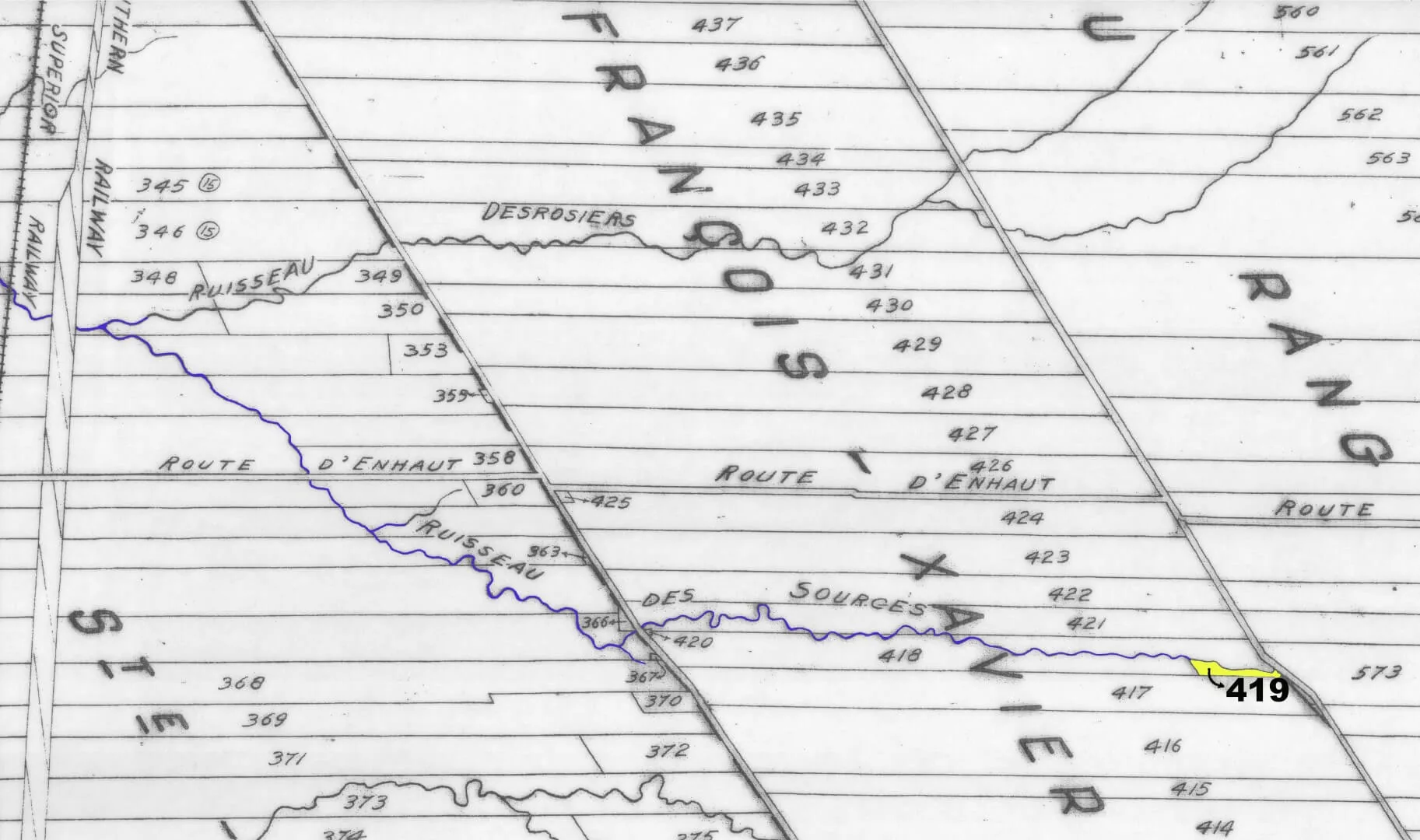
What became of Frédéric Boulanger? In May 1881 he was identified as a miller at Saint-Pierre-les-Becquets. It is possible that he went on working as a miller for Jean-Baptiste Fortier while also working his woodlot. In 1891, in the census for the Drummondville-Arthabaska district, he was a miller in the township of Stanfold, later Princeville, a settlement region then booming.
A year later, on 5 November 1881,[2] Jean-Baptiste Fortier, farmer and insurance agent of Saint-Jean Deschaillons, sold the sawmill and gristmill to Jean-Baptiste Bergeron, a farmer of the parish of Sainte-Croix. The price asked was $2,400.00, of which $1,110.00 was paid in cash. An insurance policy in the amount of $800.00 was required, a policy handed over to the seller for as long as he had not been paid in full. Note that Mr. Fortier had killed two birds with one stone: selling a property and requiring insurance that he sold himself; no profit is too small.
A few months later, on 25 February 1882, Jean-Baptiste Bergeron made a gift inter vivos[3] to his two sons, Stanislas and Joseph Bergeron, of the property known for some years as the Fortier mill.
On 20 July 1886, Sheriff Charles Dumoulin of the Trois-Rivières district received a writ of seizure from Pierre Célestin Levasseur, plaintiff, against the lands and property of Joseph and Stanislas Bergeron on account of unpaid debts.
At the church door of Sainte-Sophie-de-Lévrard, on 9 October 1886, Jean-Baptiste Fortier (the same man as in 1880), a farmer of Sainte-Philomène, was the last and highest bidder, for the sum of $1,000.00.[4]
On 2 January 1889, Jean-Baptiste Fortier, by then postmaster at Sainte-Philomène de Fortierville, sold his property on lot 419, eight perches wide by four arpents deep, together with the sawmill and gristmill and their respective mechanisms, dam and flumes, a house, a barn-stable, and all the active and passive servitudes attached to the land, to Lubin Barabé (1838-1913) and his son Thomas (1867-1939), farmers and carpenters, residents of Sainte-Sophie-de-Lévrard.
The seller reserved three spindles (axles, or the end of an axle carrying a wheel and its bearings) serving the three sets of millstones, belonging to one Lafrance, who could reclaim them on request. He also reserved the whole mechanism and the old frame (the mounting that receives a part) of the sawmill. The price paid was $1,750.00.[5]
It is possible that this Lafrance was François Lafrance, who owned a gristmill from 1888 to 1922 in the third rang, on lot 343.
The year 1903 was marked by a fine project of Lubin and Thomas Barabé. On 6 April, given the great quantity of water from the ruisseau des Sources that was going to waste even as it drove the mill, Lubin Barabé asked the municipality of Saint-Pierre-les-Becquets for permission to build a waterworks; the plan was to bring the water from the 5th rang down to the third rang and supply drinking water to those who wanted it. A permit was granted to run the water mains within the right-of-way of the lanes and roads.
On 14 May 1903 the parties appeared before the notary Henri Rivard Dufresne[6] to set out the rules and covenants concerning the waterworks. It was to be in operation before 1st October; projects came together quickly in those days. About thirty years later, that same spring would see its distribution network enlarged.
On 21 February 1909, Thomas Barabé, a merchant of Sainte-Sophie-de-Lévrard, sold lot 419 to Arthur Roux, a blacksmith of the same village. Lubin Barabé, his father, by then of independent means, approved the transaction. The sale included the mill with all its tools and machinery, the other buildings, and the water source on Octave Fournier's land, lot 417. The sale price was set at $4,000.00, of which $2,750.00 was paid in cash[7] with the discharge issued on 28 December 1924.
Before acquiring the sawmill in the fifth rang, Arthur Roux, his wife Amanda Beaudet and their children (they had 14 children, 9 of them boys) lived in the village of Sainte-Sophie-de-Lévrard; Arthur Roux owned a blacksmith shop near the church.
The year 1914 was marked by a fire that caused a great deal of damage. Arthur Roux then dealt with the manufacturing company F.X. Bertrand, machinists and founders of Saint-Hyacinthe. He bought a number of machines «telles que bouilloire, engin, moulanges et fait réparer les machines ayant subi des dommages lors de l'incendie» [such as a boiler, an engine, millstones, and had the machines damaged in the fire repaired]; the bill came to $1,000.00.[8]
On 3 June 1936, Rosaire Roux (1910-1957), industrialist, son of Arthur Roux and Amanda Beaudet, drew up a contract before a notary in view of his marriage to Lucienne Houle (daughter of Joseph and Marie Louise Marchand) of Gentilly. After the usual clauses and covenants came what was customarily added, the "marriage basket." On that occasion Arthur Roux (1869-1947) made a gift of lot 419 with everything it comprised: a mill and its fittings, the water sources, a house, a stable and other buildings, all the animals, the carriages and the entire household contents. As in most such gifts, Rosaire's father and mother lodged with the future couple, who were responsible for their well-being, security and comfort.[9]
On 8 April 1945, Rosaire Roux sold lot 419 for $4,000.00 cash to Paul-Émile and Irénée Morissette, both farmers of Sainte-Sophie. Included with the land was the sawmill (there is no longer any mention of a gristmill) with all the machinery used to run it, the house and the other buildings, as well as the blacksmith shop. Rosaire Roux reserved his workman's tools for working both wood and iron. The forge fire and bellows were included in the sale.
Irénée Morissette, unmarried, sold his undivided share in the sawmill and lot 419 to his brother Paul-Émile, who thereby became sole owner. The transaction came to $2,400.00.[10]
After running the sawmill for 16 years, Paul-Émile sold lot 419 in 1961 to Gérard Demers Inc. The sale included everything used to run the sawmill, all the farm machinery, the animals, the crops and every other item known to the buyer. Paul-Émile Morissette reserved his personal effects, his furniture and his car. Gérard Demers took what he bought as it stood, for the sum of $10,000.00.[11]
The house was sold and moved to Sainte-Marie-de-Blandford. Insulated with sawdust, it lost a great deal of it along the way, and proved hard to heat afterwards.
In 1965 the Corporation du village Les Becquets, represented by Gérard Demers, industrialist of Saint-Pierre-les-Becquets, and Louis-Pierre Roux, insurance agent, respectively mayor and secretary of the municipality concerned, bought lot 419 from Gérard Demers Inc. In that notarial act no house or building is mentioned. The price of the acquisition by the municipality of Saint-Pierre-les-Becquets was $8,000.00.
A water system serving several parishes, bringing good spring water to its users, was then built; it is the one that serves us today.
Jocelyne Lafond, SHGLB
[1] Archives Nationales act no. 21239 and no. 4415, notary Félix Bédard
[2] Archives Nationales act no. 21347 and no. 2002, notary Bonaventure Maurault
[3] Archives Nationales act no. 21567 and no. 2045, notary B. Maurault
[4] Charles Dumoulin, sheriff, no. 333 and no. 7005 in the register of discharges, A.N. act no. 26541
[5] A.N. act no. 28802 and no. 3472, notary Joseph Verville
[6] A.N. act no. 41572 and no. 637, notary Henri R. Dufresne
[7] A.N. act no. 45271 and no. 5367, notary Joseph Ludger Tourigny of Gentilly
[8] A.N. act no. 47418 and no. 2336, notary Albert Jodoin, notary of Saint-Hyacinthe
[9] A.N. act no. 60226 and no. 5840, notary David Hercule Rheault
[10] A.N. act no. 66311 and no. 4235, notary Charles Édouard Villeneuve.
[11] A.N. act no. 77171 and no. 3094, notary Normand Provencher
Where this article sits
About the Society
A group of volunteers researching, preserving and publishing the history and genealogy of the Lévrard-Becquet seigneury since 2002.
shglb.com/en/le-moulin-qui-devint-aqueduc/