Thomas-Aimé Chandonnet
Youngest of fifteen children, born at Saint-Pierre-les-Becquets in 1834, Abbé Chandonnet was an orator, a doctor of theology and third principal of the école normale Laval; from Rome he chose the painters of our church chancel.
Written in French by Yolande Allaire Roux, May 25, 2015. Quotations from period documents are left in the original. Lire l’original en français.
T.A. CHANDONNET
In the long gallery of figures who form a kind of historical fresco of our region, I will begin by naming one of them, THOMAS-AIME CHANDONNET.
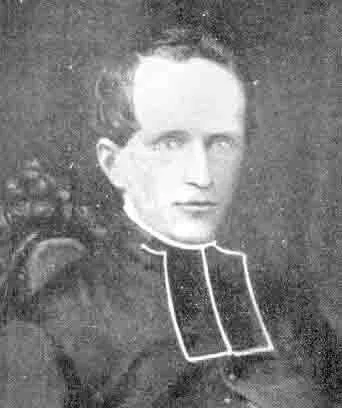
He was born at Saint-Pierre-les-Becquets on 6 December 1834, to Joseph Chandonnet and Angèle Bibeau, a native of Saint-Antoine-de-Tilly. His godfather was Godfroi Beaudet and his godmother Adèle Leboeuf. He was one child of a large family; his sister ADELINE was the second wife of Jean-Noël ROUX, great-grandfather of Louis-Pierre Roux, a native of the second rang (concession road).
Thomas-Aimé loved study; he had talent, but his parents could not afford to pay for schooling for the youngest of fifteen children. And so, thanks to the generosity of a few priests, he continued his studies until 1855, when he was admitted to the bachelor of arts, and then to theology. On 23 February 1861 he became ABBE CHANDONNET and pursued his studies in philosophy while teaching. He was appointed assistant director of the boarding school for resident students at Université Laval, then chaplain of the Société Saint-Vincent-de-Paul. His gifts were outstanding, his personality drew people in and charmed them, his students cherished him; everyone held him in esteem.
T.A. Chandonnet was a brilliant orator and writer. In 1863 he preached a memorable triduum at Notre-Dame cathedral. In 1865 the young preacher was called upon to deliver the occasional sermon for the feast of Saint-Jean-Baptiste. His eloquence as priest and as patriot shone out. These sermons and addresses were printed and distributed to the public.
In 1865, on 5 August, Abbé Chandonnet sailed aboard the “Peruvian”, a steamer that the celebrated captain J.E. Bernier would himself take some years later for Liverpool. Chandonnet was on his way to Rome to complete his studies in philosophy and theology. There, in the winter of 1867, he met Hector-Louis Langevin (1826-1906), a future prime minister of the country. On his wedding anniversary, Mr. Langevin wrote to his wife from Naples, telling her “qu’il est sur le sommet du Vésuve, et qu’il prend un verre de vin avec l’abbé Chandonnet, les guides et les porteurs, en son honneur.” [that he was on the summit of Vesuvius, drinking a glass of wine in her honour with Abbé Chandonnet, the guides and the porters].
It was during his stay in Rome that Chandonnet was commissioned by the parish priest of our parish to select renowned painters and to oversee their work. They would produce the magnificent paintings that adorn the chancel of our church, as well as the relics of our altars.
Father J.D. Déziel, founding parish priest of Lévis but former parish priest of Saint-Pierre-les-Becquets from 1837 to 1843, called on the abbé’s services to advise him in choosing the paintings for his own church. Little of an orator himself, Déziel felt some admiration for this young priest, who came from the parish he had once led and whose learning dazzled everyone.
While Abbé Chandonnet was in Rome, he was appointed to the principalship of the école normale Laval on the first of September 1867. He was 32; he was already a professor at the Quebec seminary, a doctor of theology and of philosophy, and was preparing his doctorate in canon law. He became the third principal of that teachers’ college, since renamed MERICI.
For many years this school would remain the only teachers’ college for young women in the province of Quebec.
One reads this in the Quebec City newspaper « L’ÉVÉNEMENT », run by editor-in-chief Hector Fabre: « A son retour de Rome, Chandonnet ouvrit des cours de philosophie qui attirèrent le tout Québec intellectuel. » [On his return from Rome, Chandonnet opened philosophy courses that drew all of intellectual Quebec]. In truth, what his eye was really seeking was controversy, spotting in the audience a likely opponent whom he would then harangue all the harder.
He was an ardent defender of the classical colleges!
With little gift for finances, and with his health leaving something to be desired, Abbé Chandonnet left the teachers’ college after his mother’s death in 1869. He would be remembered as a devoted professor, but hardly a teacher. Even his best students had some difficulty following him…
He then went on to teach at Saint-Francis-Xavier college in New York. On his return to this country he lived in Montréal with his sister, Madame Lavigne. His nephew was a typographer. We find him correcting proofs and writing articles for the “Revue de Montréal”.
It was there that he died, struck down by “l’apoplexie” [apoplexy], in June 1881. He was 47. One of his nephews, Mr. Alphonse Lavigne, of Trois-Pistoles, summoned in haste to Montréal, found on his uncle Thomas’s body a belt of iron wire, of 162 rings, each armed with two points, forming in all a hair shirt of 324 points applied to the bare skin.
But he would leave in the family an ardent taste for teaching well applied…
Among the teachers in the family is Mr. Zoël Tousignant, brother of grandmother Eugénie Tousignant, who held the chair of mathematics for many years beginning in September 1916. My husband’s sisters, Thérèse, Cécile and Marie-Claire, prepared their teaching certificates there… MERICI was therefore a good home for the teachers of the day…
Yolande-Allaire Roux
Where this article sits
About the Society
A group of volunteers researching, preserving and publishing the history and genealogy of the Lévrard-Becquet seigneury since 2002.
shglb.com/en/thomas-aime-chandonnet/