Father Joseph Bailey
Born at Sainte-Anne-de-la-Pérade in 1819, Joseph Bailey tended the Irish immigrants struck by typhus at Grosse-Île in 1846, then became parish priest of Saint-Pierre-les-Becquets in 1855.
Written in French by Alain Manset, May 25, 2015. Quotations from period documents are left in the original. Lire l’original en français.
Joseph Bailey, curé (parish priest).
Joseph Bailey was born at Sainte-Anne-de-la-Pérade on 3 April 1819; his father, Guillaume Bailey, was of Scottish origin, while his mother, Judith Perreault, came of French-Canadian stock. After studies at the seminary of Nicolet, he was ordained a priest at Québec on 7 January 1844, at the same time as his fellow student, the future Bishop Laflèche; he served as curate at Trois-Rivières under Bishop Cooke.
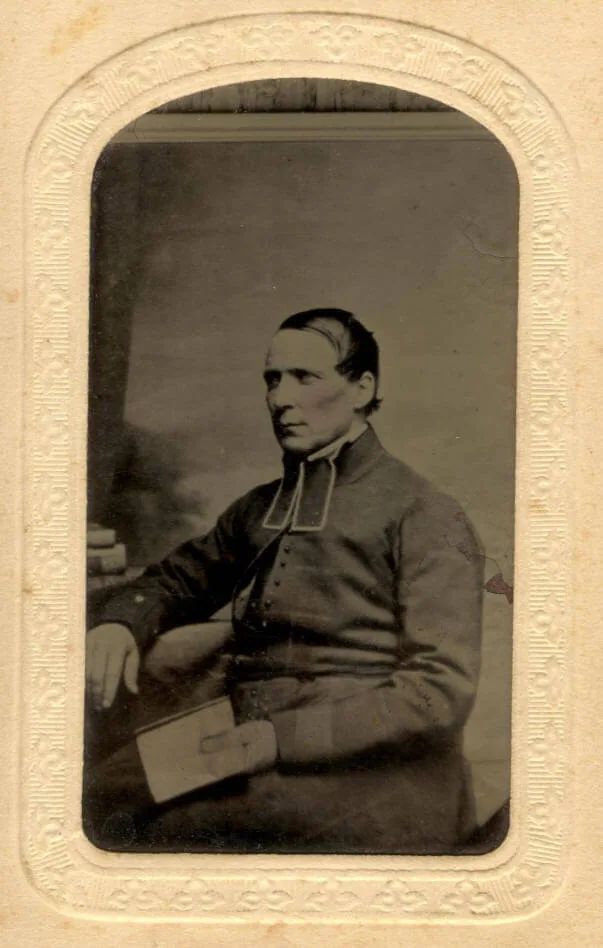
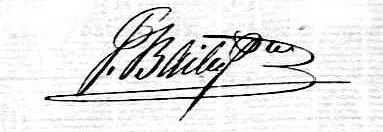
At Nicolet he showed an affable manner, a good heart and a lively character that left a fond memory behind him. He was, however, very blunt, and never hesitated to rebuff those who opposed him.
As he was perfectly bilingual, his bishop sent him in 1846 to Grosse-Île, then in the grip of a typhus epidemic; it was on that island, opposite Montmagny, that ships entering Canadian territory had to undergo a sanitary inspection; the immigrants, most of them Irish, fleeing the famine in their own country and weakened by disease, died there in great numbers; Joseph Bailey brought them help and comfort in their own language; he fell victim to typhus himself, but managed to survive.
Joseph Bailey was a promoter of public schooling, and he fought for the building of schools in his parish of Saint-Maurice. He also took an active part in the economic development of the region. It was in 1855 that he was appointed parish priest of Saint-Pierre-les-Becquets, where he went on promoting his vision of the future, in civil as well as religious matters. He was greatly appreciated by his flock. He took an active part in the decoration and ornamentation of the church of Saint-Pierre-Apôtre, built in 1839. His sister Marguerite followed him there as an « Oblate de Béthanie » [Oblate of Bethany], a religious order whose vocation is to serve priests; she was so devoted to him that, as she lay dying in her brother Joseph's arms, he said to her: « Tu m'as rendu heureux. » [You have made me happy.]
Sainte-Sophie-de-Lévrard was long regarded as a simple mission served by the parish priest of Saint-Pierre. It was in the house of Jérémie Demers, near the road of the 5th rang (concession road), that on 30 September 1856 Father Bailey celebrated the first mass on the present-day territory of Sainte-Sophie.
The parish of Sainte-Sophie received its canonical erection on 7 September 1874.
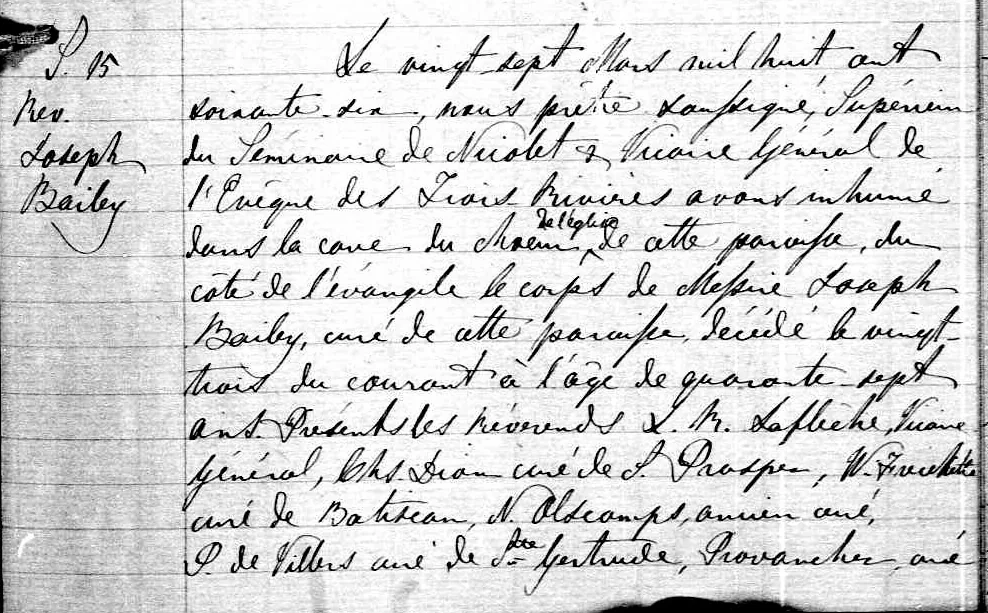
Weakened by the typhus from which he had never fully recovered, he died on 23 March 1866, at the age of 47; at his funeral on 27 March he received a stirring tribute from his fellow priests; he rests today in the vault of the sanctuary of the present church, on the gospel side, close by his sister Marguerite.
Alain Manset, Société d'histoire et de généalogie Lévrard-Becquet (Lévrard-Becquet Historical and Genealogical Society)
Notes : « Autrefois et aujourd'hui » L.S. Rheault, 1895
Archives SHGLB
Bulletin des recherches historiques, juin 1898
Recherches de Yolande Allaire-Roux
Where this article sits
Read next
About the Society
A group of volunteers researching, preserving and publishing the history and genealogy of the Lévrard-Becquet seigneury since 2002.
shglb.com/en/le-cure-joseph-bailey/