Timber
Napoleon’s 1806 blockade turned England toward Canadian timber: in the seigneurie of Lévrard-Becquet, sawmills on the rivière aux Orignaux, local dealers, and a contract dated 1830.
Written in French by Jocelyne Lafond, May 25, 2015. Quotations from period documents are left in the original. Lire l’original en français.
It is Napoleon's fault!
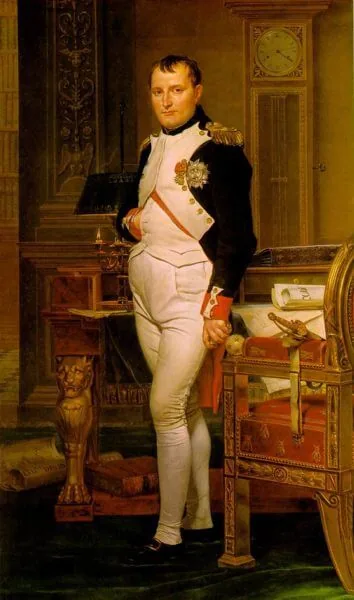
In 1806 the Emperor Napoleon imposed a naval blockade against the United Kingdom, in order to keep it from trading with his European empire; England was thus pushed to turn to Canada for its supply of shipbuilding timber. A few years later Napoleon was forced to abdicate, and the British navy came to dominate the seas of the world. England needed a great many ships, both naval and merchant, to maintain its supremacy, and that called for large quantities of quality timber: oak for the frames, white pine for the masts; the planking was red pine and the keel beech; certain woods were reserved exclusively for warships.
In this context, our region supplied great quantities of lumber, for the navy and for all the construction that flowed from the economic activity of the English, in Canada as much as in Great Britain.
Many inhabitants of the seigneurie (seigneury) of Lévrard-Becquet adapted to the new conditions of the market and diversified their usual activities. Several trades then developed in the region; some men became timber merchants, others felled the great trunks, hauled them to the sawmills being built along the banks of the rivière aux Orignaux, and cut them to the required dimensions. Under the seigneurial regime, before 1854, the seigneurs held every right over the use of the watercourses, and therefore over the mills, and over the cutting of wood on unconceded land; inhabitants could exploit it in return for a due, but it was after 1854 that the sawmills saw their greatest expansion; a fair number of sawmills were leased along the rivière aux Orignaux, often on five-year leases.
The activity of this market can be followed through the many notarial contracts of the period. The local traders were the agents of Québec merchants; the most active of these local dealers was perhaps Wilbrod Demers, who acted as intermediary for James Gibb, Peter Patterson and Benson Bennet. One also finds names such as Numédique Mailhot, Placide Chandonnet, Joseph Charland, and many others who knew how to profit from the strong demand for lumber.
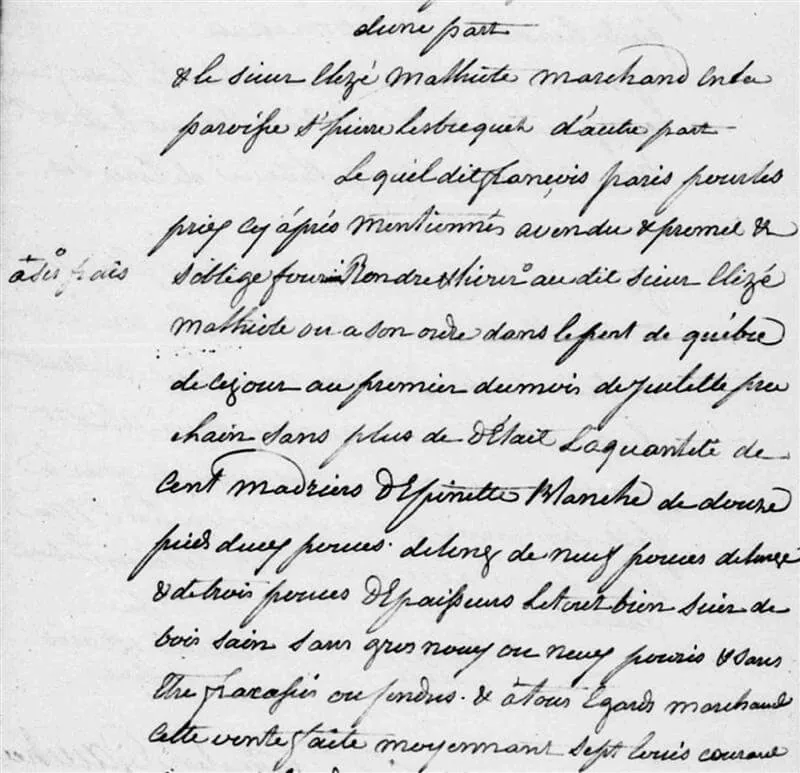
Here we may read a contract, dated 1830, between Elizé Mailhot and François Paris, who « pour les prix cy après mentionnés a vendu et promet et s'oblige fournir, vendre et livrer au dit sieur Elizé Malhiote ou à son ordre dans le port de Québec de ce jour au premier du mois de juillette prochain sans plus de délait. » [for the prices hereafter mentioned has sold, and promises and binds himself to furnish, sell and deliver to the said sieur Elizé Malhiote or to his order in the port of Québec, from this day to the first of next July, without further delay]. As one can see, spelling « au son » [by ear] was already the fashion!
Where this article sits
About the Society
A group of volunteers researching, preserving and publishing the history and genealogy of the Lévrard-Becquet seigneury since 2002.
shglb.com/en/le-bois/