Domaine de Lapérade
In 1844, deep in financial trouble, François Baby had Pierre-Louis Morin lay out seventeen arpents as 99 building lots; in nine years only a dozen were granted.
Written in French by Jocelyne Lafond, May 25, 2015. Quotations from period documents are left in the original. Lire l’original en français.
François Baby, real-estate developer
Charles-François-Xavier Baby was born in 1794; his father was François Baby and his mother, Marie-Anne Tarieu de La Naudière.
François Baby, real-estate developer.
1844…
François Baby was in serious financial difficulty; to get himself out of trouble, he hit upon the idea of subdividing a large piece of land he owned into small lots meant for the building of individual houses. He was probably also protecting his rights, for a few months later the Municipalities Act came in to regulate the administration of certain settlements; in fact Saint-Pierre-les-Becquets became a parish municipality in 1845.
He commissioned the surveyor Pierre-Louis Morin to draw up a plan of what he would name the « Domaine de Lapérade », in honour of his mother, Madame Tarieu Lapérade de La Naudière; the plans were presented in December 1844.
This land, seventeen arpents in size (an arpent is an old French measure of about 0.85 acre), was bounded on the north by the cliff and the manor house; on the south by a gully cutting his farm in two; on the east by Joseph Dionne’s land, and on the west by the parish church’s grounds. The surveyor Pierre-Louis Morin laid out 99 building lots, 10 of them irregular in shape because of the ravine to the south and of Chaillez’s inn at the north-east corner; all the others were identical, 50 feet by 77. The lots were distributed over nine blocks separated by streets meeting at right angles, a resolutely modern arrangement. In fact, many present-day subdivisions adopt a comparable overall plan and similar dimensions.
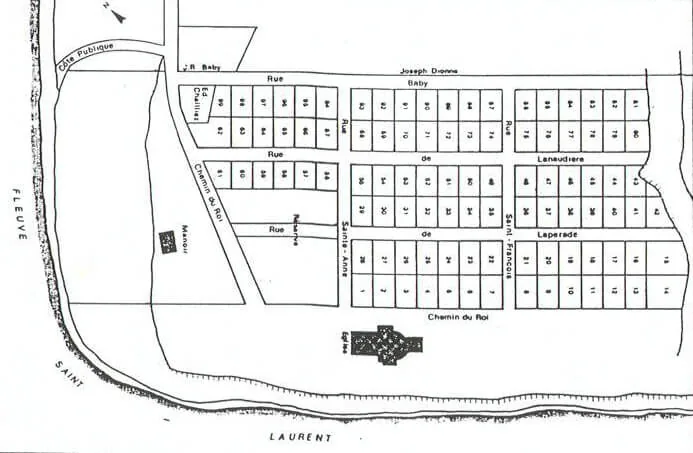
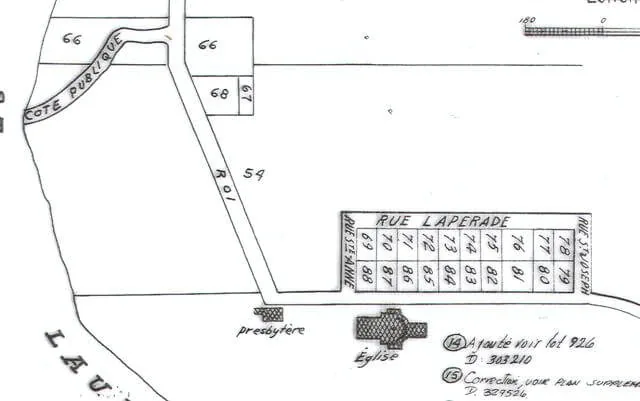
Above, the 1844 plan presented by the surveyor Pierre-Louis Morin
Below, what had actually been built of the Domaine de Lapérade by 1872
The deeds of sale for these small lots carry a great many requirements: the obligation to fence the land, to maintain the adjoining roads, to build a house 25 feet by 25 within the year and to whitewash it every two years. The land was also subject to a ground rent of one pound ten shillings a year, and the seller reserved the right to seize the lot if certain conditions were not met. A few lots found takers in the years that followed, and several houses went up. François Baby does not appear to have been obliged to seize any lot for breach of covenant; but how many prospective buyers were put off by these requirements, history does not say.
François Baby, however, scattered his efforts: he logged the region’s forests, owned ships, obtained contracts for the building of wharves and lighthouses, for a railway on the north shore, for a ship-towing service between Québec and Le Bic, not to mention his farming activities at Saint-Pierre. In fact he left the little community to settle in Québec City; he took less interest in his property venture, and it stalled. In ten years only a dozen lots had been granted.
Thus, on 14 December 1844, two lots were granted: number 86 (following the designation of the 1872 cadastre, the land register, still in force today) to Louis Mainguy, farmer, and number 87 to Joseph Côté, shoemaker. In 1845, on 16 June, Josué Brisson, farmer, became the grantee of lot 88.
Five years would pass before another lot was granted — number 81, to Augustin Poudrier, a plasterer by trade; this took place on 14 March 1850. Note that on the 1844 map lot 81, wider than the others, took in, over and above the “normal” lot, the space set aside for rue Saint-François, which was never opened.
Then, on 28 January 1851, François Magny, ferryman, acquired lot 85, followed the next day by Eusèbe Coulombe, shoemaker, who became the owner of the neighbouring lot, number 84. On 6 June 1851, Lucie Jacques, of no occupation (women did not work in those days), acquired lot 80.
A few months later, on 27 December 1852, Siméon Charland, tinsmith, became the owner of lot 79. In this way nearly all the lots facing the church grounds were taken up.
Finally, on 25 July 1853, lots 69, 70, 71 and 73 were granted respectively to Luc Matte, joiner; François Courteau, also a joiner; Jacques Marcellin, farmer; and Magloire Baril, merchant. A busy day for the notary Félix Bédard…
In nine years only a dozen building lots were granted; out of the hundred planned, that is very few. And it seems that until François Baby’s death in 1864 not a single further lot would be granted. Why?
Since the land was granted rather than sold outright, there was no sale price but annual payments in perpetuity, like a rent: a cens [a seigneurial due]. The yearly rent of one pound ten shillings, the equivalent of seven piastres (dollars) of the day, was fairly high for a small lot, but justified by its situation in the very heart of the village. A transfer duty of ten per cent of the value of the property fell on the new owner. All of this, though, was perfectly acceptable at the time.
The requirements as to the building deadline do not seem to have discouraged buyers; every house was built within the prescribed time.
The constraints arising from the closeness of the neighbours — whitewashing the fence and the house every two years, opening and maintaining the roadways — were readily accepted.
It also seems that François Baby had more interesting and more lucrative sources of income; his timber trade, his farming, shipping and railway ventures, the seigneurial dues, his building contracts must all have looked more attractive. Parting with a parcel of land for a modest return no longer appealed to him as much. Moreover, he now lived in the great city of Québec, and had lost interest in a project that had struggled to get started.
According to Jacques Crochetière, the absence of any commercial establishment, manufactory or works gave people no reason to settle in the village, and that would be an inescapable factor explaining the failure of the project. It remains entirely topical: even as we speak, the chief preoccupation of the municipal council is still to attract engines of the economy, which are a guarantee of survival.
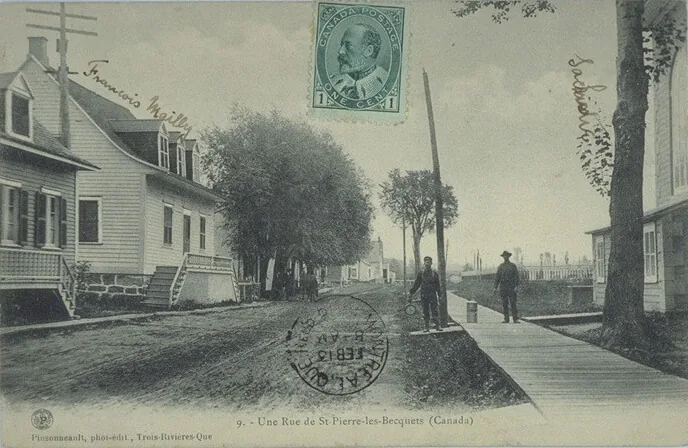
What remains of the project is a group of houses along rue Marie-Victorin, facing the church grounds, and the houses of rue Lapérade. Several date from the years around 1845.
Sources: a very large part of the facts related here come from the excellent work of Jacques Crochetière and from research in the Archives nationales du Québec.
Where this article sits
Read next
About the Society
A group of volunteers researching, preserving and publishing the history and genealogy of the Lévrard-Becquet seigneury since 2002.
shglb.com/en/domaine-de-laperade/